The poster is still blank and the class is already arguing about whether a piggy bank counts as a way of saving or just a place to keep coins. That argument is the point, and the mental map examples on this page are built around it. A mental map gives a group somewhere to put every idea before anyone decides which ideas are good, and the sorting that follows is where the learning happens.
The method described here comes from the Regional Teachers Training Center in Łódź, Poland, where it was written up as a general-purpose tool for creating and defining concepts, preparing notes, planning and building strategies. It goes by several names: map of thoughts, brain map, concept map. The idea underneath does not change. It is a graphic presentation of thoughts and the simple associations people make with one topic.
What a mental map looks like in a real classroom
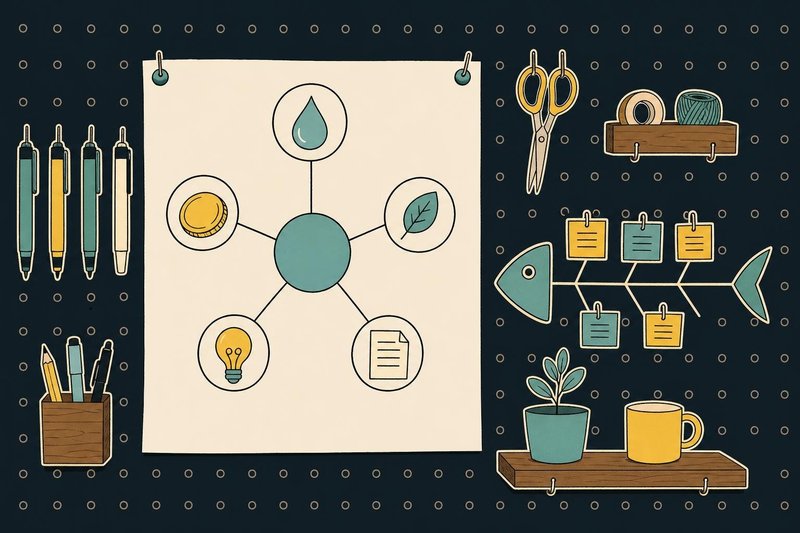
A mental map can take the form of a spider’s web, a fish skeleton, a network or a block scheme. It can be built from drawings, pictures, newspaper cut-outs, symbols or words, using whatever makes the ideas easiest for this particular class to see. That flexibility is why the method travels so well between age groups. Year 3 pupils glue pictures; sixth-formers draw arrows and argue about causality.
The two mental map examples below were developed for financial education, which suits entrepreneurial learning, but the structure works for any subject. Teachers in Łódź used them as complete lessons; both fit comfortably into a single period.
Mental map examples, part one: the spider web on ways of saving
This is the gentler of the two mental map examples and the better place to start in the classroom.
- Talk with the class about different ways of saving: money, water, paper, energy, health.
- Write the key concept, Methods of saving, in the middle of a large sheet.
- Split the class into groups and hand out paper, markers, crayons, coloured pens, old newspapers, scissors and glue.
- Each group creates its own slogans as drawings or symbols linked to one strand: health, water, paper, the environment or energy.
- Groups write, draw or cut and stick their items in place on their strand.
- Each group presents its part, and selected pupils explain what they chose and why it belongs there.
- All the group maps are joined into one class map of ways of saving.
- The teacher sums up how the groups worked together.
Step six matters more than it looks. A child explaining why a dripping tap belongs under water and not under money is doing the categorising that the whole exercise is for.
Example two: the fish skeleton on why money disappears (older pupils)
The fish skeleton is a cause-and-effect map, so it asks for more abstract thinking. Open with the everyday phrases people use about careless money: it slips through your fingers, there is a hole in your pocket, count every penny, go broke. Then ask the class directly how people lose money and possessions, and what causes it.
Pupils brainstorm reasons, write each one on its own card, and stick the cards onto the bones of a large fish skeleton drawn on the board or on paper. The head of the fish is the problem; each bone is a family of causes. Typical bones that classes arrive at include buying on impulse because of friends or advertising, buying things nobody needs or of poor quality, borrowing money that will be hard to pay back, not insuring possessions, habits such as smoking, and plain carelessness with clothes and belongings.
Expect at least one group to put laziness on the skeleton, meaning not doing paid jobs such as babysitting or taking out the rubbish when the chance comes. It is a good moment to talk about earning as the other half of the money question.
Where mental map lessons tend to go wrong
The most common failure is a beautiful poster and no thinking. When the map becomes an art project, groups spend forty minutes on lettering and two on ideas. Set a rule that each item must be explained aloud by someone other than the person who drew it, and the balance shifts.
The second failure is ending the lesson at the presentations. The merge into one class map, and the teacher’s short summary of how the groups worked, is where pupils see that their separate pieces add up to something none of them had alone. Cut the decoration time before you cut the merge.
Third, avoid giving the central word too early in a revision lesson. If the aim is to find out what pupils already know, let them suggest the centre and see what they choose.
What pupils take away from a mental map
The learning outcomes set out for the method fall into four areas: organising information and seeing how one piece relates to another; building and remembering knowledge; enterprising behaviours such as teamwork, creative thinking, problem-solving, communication and presenting; and research habits pupils can reuse in later work. Teachers who tried it also pointed out that it suits children who cannot yet read and write, because a picture or a symbol is as valid as a word on the map.
Fitting a mental map into the timetable
A mental map works in an ordinary timetabled lesson, during a suspended-timetable day, or as part of an after-school club. It supports most national curriculum subjects, and once pupils know the shapes they start using them on their own to organise their thinking, which is the best sign the method has taken.
Assessment happens in the debrief: pupils and teacher together look at the final map and talk about what is on it and what is missing. For a planning task, pair the map with the FIRE design process and use the map as the Facts stage; for idea generation, a deck such as Creative Cards gives groups a structured next step once the map is full.
Leave the finished class map on the wall for a week and invite pupils to add to it whenever a new idea turns up in another lesson.
Questions teachers ask
What is a mental map in teaching?
A mental map is a drawing of how ideas connect around one central concept. Pupils put the concept in the middle and add words, symbols, pictures or cut-outs for everything they associate with it, then link related items. In class it is used for brainstorming, revision, planning and summing up what a group already knows.
Which mental map examples work best with young children?
The spider web works best. One word goes in the middle, for example ways of saving, and children add pictures and symbols around it. Because drawings and newspaper cut-outs count as much as words, a mental map works even with children who cannot yet read or write fluently.
How is a mental map different from a mind map?
In everyday classroom use the two names cover the same thing. Some teachers keep mind map for the neat radial diagram and use mental map, concept map or brain map for any freer shape, including the fish skeleton, the network and the block scheme described on this page.
How do I assess a mental map lesson?
Assess the talk, not the drawing. During the presentations, listen for whether a group can explain why an item sits where it does and how two items connect. A short debrief in which pupils say what they would move on the map tells you more than marking the poster.
Published 19 October 2026